


WITH the arrival of a seven-seat MPV and a larger model on the way, could Kia’s new generation of electric people carriers challenge the established players in the chauffeur industry?
Paul Gibson gets behind the wheel.
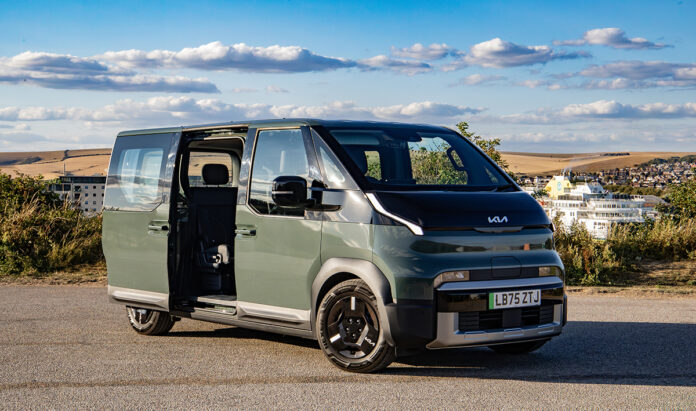
The arrival of the Kia PV5 Passenger is particularly interesting for an industry which has become heavily reliant on the Mercedes-Benz V-Class over the past decade.
While Kia may not be a manufacturer traditionally associated with the chauffeur market, its latest electric vehicle offers an interesting combination of space, technology and competitive pricing which makes it difficult to ignore.
The PV5 is the first vehicle to emerge from Kia’s new PBV (Platform Beyond Vehicle) strategy, based on a dedicated modular electric platform designed to accommodate several different body configurations.
These include Cargo, Passenger, Crew and Wheelchair Accessible models, with the manufacturer already announcing plans for the larger PV7, due to arrive in Europe in 2027, and the PV9 in 2029.
Could it be a rival to the V-Class?
The PV5 is certainly a distinctive-looking vehicle. Its futuristic styling attracted plenty of attention during my time with the Cargo version, and the Passenger is arguably the more attractive of the two and obviously more suitable for our industry.
Its proportions are considerably different to those of the larger Mercedes-Benz V-Class, placing it closer to the Volkswagen ID. Buzz in terms of its market positioning.
The introduction of a seven-seat derivative is particularly significant for the chauffeur industry, although there is a considerable difference in luggage capacity between the two versions.
The five-seat model offers an impressive 1,330 litres behind the second row, increasing to 3,615 litres when the rear seats are folded.
However, the seven-seater, which features a 2-2-3 seating configuration, offers just 318 litres with all seats occupied. This increases to 785 litres with the third row folded.
It is here that the extra-long Mercedes-Benz V-Class retains a significant advantage for airport transfer work involving larger groups.
What’s it like for passengers?
One of the biggest advantages of Kia’s dedicated electric platform is the amount of usable interior space it provides.
The low, flat floor and generously proportioned sliding doors make access particularly good, with a step-in height of just 399mm and door openings measuring 775mm.
Second-row passengers benefit from generous legroom, reclining seats, ventilation outlets and USB-C charging points.
The interior is modern and functional rather than luxurious. Those expecting the executive surroundings of a high-specification V-Class will be disappointed, but Kia’s Elite specification goes some way towards addressing this.
Elite models feature electrically operated sliding doors, two-tone artificial leather upholstery, ventilated front seats and a surround-view camera system.
Behind the wheel
Modern commercial vehicles have become remarkably enjoyable to drive, and the PV5 goes a long way towards disguising its commercial origins.
The driving position is comfortable and the dashboard has much in common with Kia’s established electric car range, with a 12.9-inch infotainment touchscreen alongside a 7.5-inch digital instrument display.
There is an impressive amount of storage throughout the cabin, thanks largely to the flat floor and absence of a conventional transmission tunnel.
One criticism I had of the PV5 platform was the particularly wide A-pillars, which require additional care when checking for traffic at junctions.
The Long Range model produces 161bhp and 250Nm of torque, with the smooth delivery of power from the electric motor suiting the nature of the PV5 particularly well.
Range and charging
Kia offers two battery options in the five-seat model, with the 51.5kWh Standard Range version capable of a claimed 183 miles and the 71.2kWh Long Range increasing that to 256 miles.
The seven-seat model is exclusively available with the larger battery and offers a claimed range of up to 246 miles.
A 10 to 80 per cent recharge takes approximately 30 minutes under suitable conditions, while the centrally positioned charging port at the front of the vehicle is a particularly practical design feature when using public charging facilities.
How much does it cost?
Perhaps the most interesting aspect of the PV5 Passenger is its pricing.
Following the application of the £1,500 Government Electric Car Grant, UK prices start at £31,695 for the five-seat Essential, with the Long Range version costing £34,695.
The seven-seat Essential starts at £35,000.
Is the forthcoming PV7 worth waiting for?
While the PV5 is an interesting proposition, it is perhaps the forthcoming PV7 Passenger which should be attracting the attention of the chauffeur industry.
Unveiled at IAA Transportation in Hanover in September, the PV7 is considerably larger than the PV5 and is scheduled to arrive in Europe during the second half of 2027.
Available in Compact and Long wheelbase configurations, the Passenger version will accommodate up to nine occupants, with flexible seating arrangements, dedicated rear climate controls, electrically operated sliding doors and a greater emphasis on interior refinement.
The PV7 will also benefit from Kia’s 800V electrical architecture, with a choice of 71.5kWh and 96.2kWh batteries and power outputs of up to 268bhp.
Kia is targeting a range of more than 285 miles for the Long Range Cargo derivative, although official figures for the Passenger have yet to be confirmed. Charging from 10 to 80 per cent is expected to take around 25 minutes using a suitable rapid charger.
The larger dimensions and more flexible interior could make the PV7 a far more credible challenger to the Mercedes-Benz V-Class and its forthcoming electric successor, the VLE.
Verdict
The Kia PV5 Passenger shouldn’t necessarily be viewed as a direct replacement for the V-Class, particularly for operators working at the premium end of the market.
However, with Long Range versions available for less than £35,000, its competitive pricing, generous interior space and extensive equipment make it an interesting addition to the electric MPV sector.
Having experienced both the Cargo and Passenger versions, I’ve been particularly impressed by what Kia has achieved with its dedicated PBV platform.
The PV5 may not quite tick all the boxes for the traditional chauffeur operator, but it provides a good indication of what we can expect from the manufacturer in the coming years.
If Kia can maintain its competitive pricing while delivering the additional space, range and refinement promised by the PV7, the established manufacturers in this sector may well have something to worry about.