

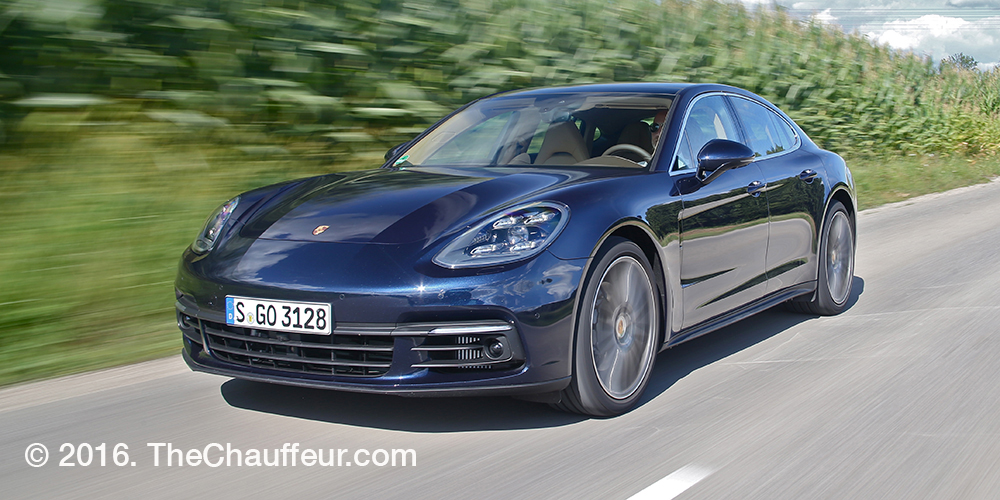

The new Panamera Turbo is the best sports limousine in the world.
Consider the words above carefully. I use the term best sports limousine rather than sports saloon, because at 5,049mm long and 1,935mm wide, Porsche’s new Panamera is roughly 50mm shorter, but about 40mm wider than the normal wheelbase versions of BMW’s 7-Series and the Mercedes S-Class.
Originally designed to attract sporty drivers who needed four seats with its 911 design cues, the first generation Panamera had mistakes in its rear proportions that hampered it from beating the much prettier but far less practical Aston Martin Rapide in the beauty stakes.
If you have never considered the Porsche Panamera as VIP chauffeur transport the Chinese certainly have. Not only was the world’s largest car market considered so important that Porsche launched the first generation Panamera at the 2009 Shanghai Motor Show, a 150mm longer wheelbase Executive version for China was launched at facelift time in 2013, and subsequently became available in other markets.
Like its predecessor, the all-new Panamera features 4WD as standard, which makes it an interesting alternative to the Audi A8 if you live in wet and snowy places and are not a fan of SUVs.
Unlike its predecessor the new Panamera is sleek and attractive rather than bordering on awkward, the total redesign taking more 911-like design cues in its roofline and rear side windows.
The lighter and stiffer steel and aluminium hybrid structure is based on the new MSB (Modular Standard Drivetrain) platform developed by Porsche for the VW Group. The car is made in Porsche’s Leipzig factory, and two wheelbase variants are possible, so expect a LWB version and maybe even a Tourer.
Thanks to greater demands of passive and active safety, not to mention the plethora of new assistance systems, each model is very slightly heavier, with the Turbo weighing 25kg more at 1,995kg.
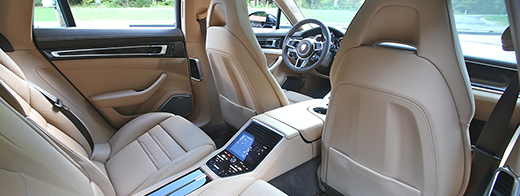
Structural changes include a 30mm longer wheelbase, which now measures 2,950mm. With the front wheels moved ahead slightly to shorten the front overhang, the result is a longer wheelbase and an interior with more leg and headroom that easily accommodates four 1.93m tall occupants in comfort. The 40/2/40 split folding rear seat arrangement is very practical and boosts overall luggage capacity of the already capacious 495-litre boot to 1,304 litres.
Beautifully crafted from high-quality materials, the cabin is a masterpiece of fusion between modern styling, traditional materials, and cutting edge telematics, centred around the 12.3-inch PCM display, and assistance systems including night vision cameras. With the emphasis on iPad-like touch screens, the only downside is the fact that these shiny black surfaces have to be cleaned frequently to stay looking their best.
Comfort features like fan cooled and massage seats add to occupant appeal, while the LCD screen on the backs of the front seats are options to keep VIPs happy in the rear.
With around 60-percent more air volume than the previous two-chamber design the new three-chamber active air suspension system has a much greater spread of abilities both in comfort at one end and sporty performance at the other. Add the PDCC Sport, which includes PTV Plus electro-mechanical active roll compensation and you have a system that supports comfort and superior driving dynamics across the board.
Comfort is more than just being possessed of a good primary and secondary ride. NVH is also a crucial element in a car capable of covering big distances and delivering its occupants in a fresh and unruffled state, and here Porsche has really pushed the boat out.
While the 19-inch wheels wear conventional rubber, the 20 and 21-inch tyres use a layer of special damping foam inside to address low road noise. This is a technology introduced by Continental for the Mercedes-Maybach in early 2015, and is now used by all four of Porsche’s tyre suppliers.
Hydraulic air suspension systems cannot react as quickly as electronically controlled ones. But as significant quiescent current and instantaneous headroom is required in the system to move the great masses involved, the new Panamera is the first Porsche to adopt a partial 48-Volt electrical system for specific applications such as the suspension. At the same time, the huge volume of data transfer requires a partial FlexRay high-speed network linked to the conventional CAN-BUS system.
The bi-turbo petrol V6 and V6 and V8 diesel engines are Audi derived, while the new bi-turbo petrol V8 was developed in-house. The petrol 440hp/550Nm V6 and 550hp/770Nm V8 are 14.0kg and 9.5kg lighter than their predecessors respectively, the V8 being built in Zuffenhausen, and the V6 at Audi’s engine plant in Győr, Hungary.
To help fuel economy and emissions, the V8 petrol engine features cylinder deactivation via two-stage, hydraulically actuated sliding cams on the intake and exhaust camshafts.
All this efficient engineering certainly pays off in the real world, and in a morning of mixed driving, which included town and high-speed autobahn work, I achieved an average of 12.3L/100km (22.9mpg Imperial or 19.1mpg US). Although Porsche claims 9.4 L/100km mixed for the EU standard test, this is still impressive real world economy for a two-ton car propelled by a 550hp V8.
The refinement of the lusty bi-turbo V8, the seamless upshifts of the ZF eight-speed automatic gearbox, the rock solid aerodynamic and chassis stability contribute to this feeling of unassailable supremacy both in a straight line and when the road becomes twisty.
With 422hp from 3,500 to 5,000rpm, and a whopping 850Nm of torque between 1,000 to 3,250rpm, the bi-turbo V8 diesel in the Panamera 4S covers the 0-100km/h sprint in 4.1 sec and reaches 160km/h in 10.7 sec, with 200km/h coming up in 16.8 sec, making it the fastest production diesel car money can buy. With a claimed combined consumption of 6.8 L/100km (41mpg), it is also very economical, but the Audi-derived 3.0 litre V6 diesel due later will be the ideal choice for chauffeurs.
I expected the second generation Panamera to be good, but the depth and breadth of the cars dynamic abilities took me by surprise. Combining near limousine like ride quality with sports car like handling was always going to be a pretty tall order. But the engineers have succeeded spectacularly, and owners of the new Panamera will not have to apologise for the styling either!
Report and Pictures: Dr Ian Kuah